
An engineering-based solution
We repair and strengthen petrol and hybrid combustion engines. Work includes measurements, block and head machining, timing systems, crankshafts and rotating assemblies. For higher-output builds, pistons, rods, bearings, fasteners and clearances are selected for the engine, fuel and intended load.
Every car is assessed individually. We agree on the scope and explain the options before starting repairs or tuning.
Aftermarket pistons change rotating-assembly mass
An aftermarket piston can weigh substantially more or less than a factory item. Pins, rings, clips and rods can differ too. Crank counterweights work with a particular reciprocating and rotating mass, so simply fitting new parts is insufficient.
Different component mass changes engine balance. At higher rpm this can increase vibration and bearing loads and shorten component life. A kit specifically designed to retain factory balance may be an exception, but its component weights are still checked before assembly.
In-house crankshaft balancing
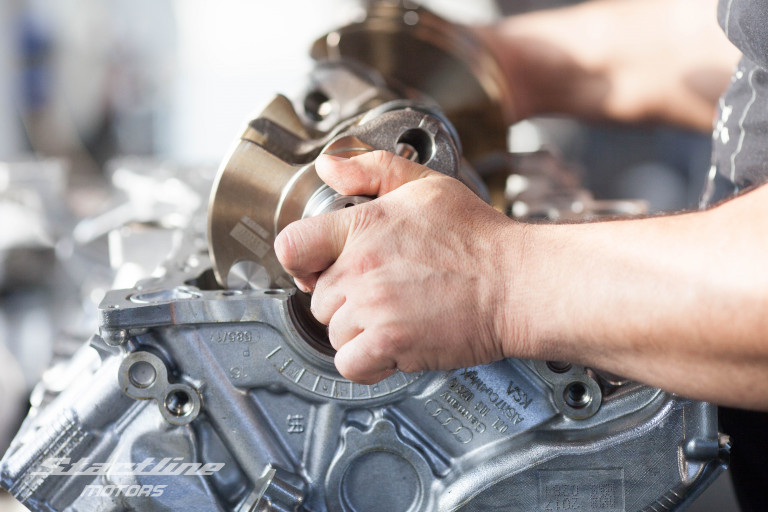
We weigh pistons, pins, ring sets, clips and rods individually, checking rod big- and small-end weights separately. Components are weight-matched and the balancing weight calculated for the final assembly.
The crankshaft is then dynamically balanced. Where required by the design, we include the flywheel, clutch or torque-converter drive plate and damper, matching the assembly to the components actually installed.
Strengthening an aluminium block with iron liners
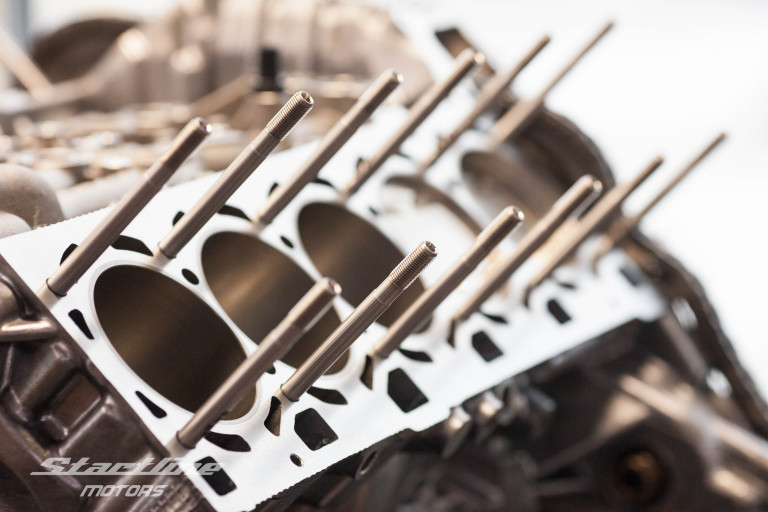
An iron or ductile-iron liner is more than a tube pressed into an aluminium block. Different thermal expansion requires accurately prepared supports, flange seats and interference. Too little interference compromises retention and heat transfer; too much can create stress and distort the bore when hot.
Controlled block and liner temperatures allow installation without damaging the aluminium. Dry, wet and flanged liners use different support, retention and sealing methods. Selection depends on block design and intended cylinder pressure.
After installation and stabilisation, final boring and torque-plate honing simulate cylinder-head clamping load. We recheck roundness, taper, liner position, deck and main-bearing alignment, preparing deck finish and liner height for the chosen gasket and liner system.
Changing cylinder-wall material means factory clearances cannot simply be copied. Piston clearance and honing finish depend on the iron liner, piston alloy, skirt coating and ring manufacturer’s requirements. Bores and oil and coolant passages are thoroughly cleaned before final assembly.
2618, 4032, cast and steel pistons
High-output petrol engines commonly use forged 2618 or 4032 aluminium pistons. The more ductile 2618 alloy tolerates heavy cylinder loads but expands more, requiring greater cold clearance and potentially noisier cold operation.
High-silicon 4032 expands less, allowing tighter clearances and often suiting quieter, longer-life road builds. Cast and hypereutectic pistons have different limits; some heavily loaded diesels use steel pistons. Material must be selected with piston design, cooling, output and use in mind.
| Property | 2618 forged aluminium | 4032 forged aluminium | Cast / hypereutectic | Plieninis |
|---|---|---|---|---|
| Typical application | Very high output and racing loads | High-output road or longevity-focused builds | Factory or moderately loaded engines | Heavy-duty diesel engines |
| Thermal expansion | Didesnis | Lower due to higher silicon content | Usually lower, depending on alloy | Assessed with piston and cooling design |
| Cold clearance | Usually greater | Can be smaller | Close to the factory approach | According to the specific manufacturer’s system |
| Resistance to extreme loads | Very good; more ductile alloy | Good, but less ductile | More limited under severe knock or heat loads | Very high, with different construction and cooling |
| Cold operation and wear | Can be noisier; warm-up is important | Quieter and often more resistant to long-term wear | Quiet; designed for factory operation | Not directly comparable with aluminium pistons |
| Svarbiausia surenkant | Manufacturer’s clearance, rings and expected temperature | Accurate measurement and suitability for use | Stay within intended load limits | Follow the engine’s cooling, liner and clearance requirements |
Clearances are specific to the build
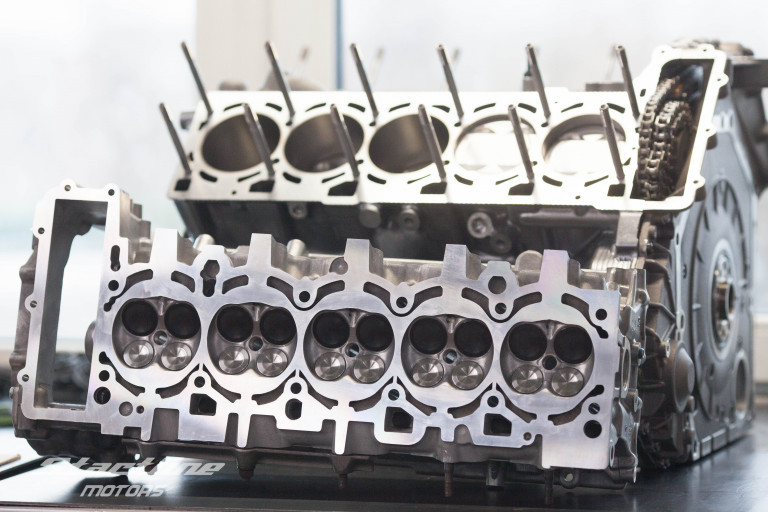
Piston clearance is selected using the manufacturer’s measuring point and guidance, alloy, coating, cylinder and block material, expected temperature, pressure and fuel. Each cylinder is machined to the measured piston, not just a nominal catalogue diameter.
Ring end gaps are set and checked in each bore. Insufficient gap can close when hot and damage the ring, piston or bore; excessive gap can impair sealing and increase blow-by and oil consumption. Gaps are calculated and measured for the actual specification.
Quarter mile and half mile: different demands
Engine design considers full-load duration, rpm, vehicle mass, grip, gearing and terminal speed, as well as power. Quarter-mile performance requires launch response, a broad usable range and torque delivery that does not overwhelm tyres or transmission.
Half-mile runs keep the engine at full load and in high gears longer. Increasing aerodynamic resistance demands sustained top-end power. Pistons, rings, valves, turbos, oil, coolant and intake air experience longer heating periods.
Turbo sizing, turbine housing, cam timing, compression ratio, rpm range and gearing can therefore differ. A responsive quarter-mile setup may reach flow or backpressure limits over a longer distance. A higher-flow half-mile turbo and longer gearing may respond more slowly at launch.
Quarter-mile engines face severe transient cylinder-pressure and driveline loads. Half-mile engines experience full load over more high-rpm cycles, making thermal stability, lubrication reserve, bearings, piston cooling and fatigue particularly important.
Clearances depend on temperature, not the event name
Half-mile use does not mean every clearance should be larger. Piston, ring and bearing clearances depend on materials, pressure, rpm, oil and stabilised temperature. Sustained load often needs more thermal reserve, but excessive clearance also harms sealing, oil control and cold operation.
Bearing clearances, oil viscosity, pump flow and oil-temperature control are designed together. Ring gaps likewise depend on bore, piston alloy, ring design, fuel and cylinder pressure, rather than being copied from another engine with similar output.
A powerful quarter-mile engine is not automatically prepared for half-mile use, and a sustained high-speed setup may not launch fastest. One car can suit both, but its engine, turbos, cooling, fuel system and transmission must handle the more demanding load scenario, with suitable calibration for each event.
- Block, bore, crankshaft and bearing-housing measurements
- Weighing and matching pistons, pins, rings and rods
- Bobweight calculation and dynamic crankshaft balancing
- Liner seat, support and retention preparation
- Final bore machining and torque-plate honing
- Setting piston, ring-end and bearing clearances
- Matching power range and thermal reserve to quarter- or half-mile loads
- Assembly, control measurements and pre-start checks