
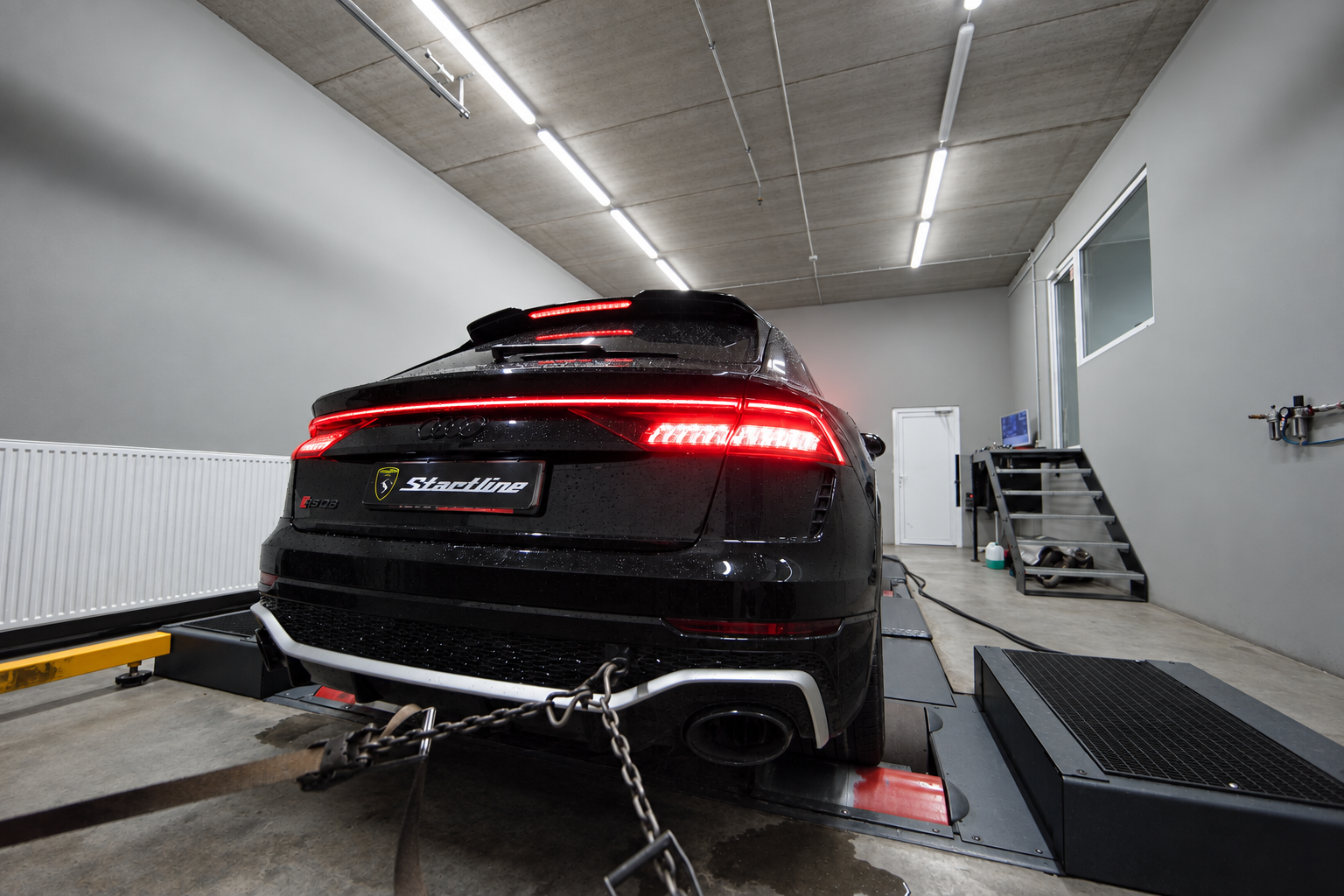
This Audi RS Q8 build was about overcoming charge-air cooling limits as well as increasing peak power. We replaced two separate small intercoolers with one large core intended for the Nissan GT-R platform and adapted the entire charge-air route. Together with hybrid turbos, exhaust modifications and custom calibration, it delivered 967.7 PS and 1264.3 Nm on the dyno — the build we refer to as our 960 HP project.
What changed in this RS Q8 build
| Mazgas | Original specification | Startline sprendimas |
|---|---|---|
| Charge-air cooling | Two separate smaller intercoolers | One large Nissan GT-R core and custom pipework |
| Turbokompresoriai | Factory turbos | Hybrid turbos prepared for increased airflow |
| Exhaust | Factory exhaust system | Exhaust adapted to reduce restriction |
| Stendo rezultatas | 600,8 PS / 790,8 Nm | 967,7 PS / 1264,3 Nm |
| Kuro tiekimas | Factory high- and low-pressure fuel pumps | Higher-flow high-pressure pumps and a Startlinemotors low-pressure pump controller with power amplifier |
| Valdymas | Factory calibration | Coordinated boost, fuel and torque management |
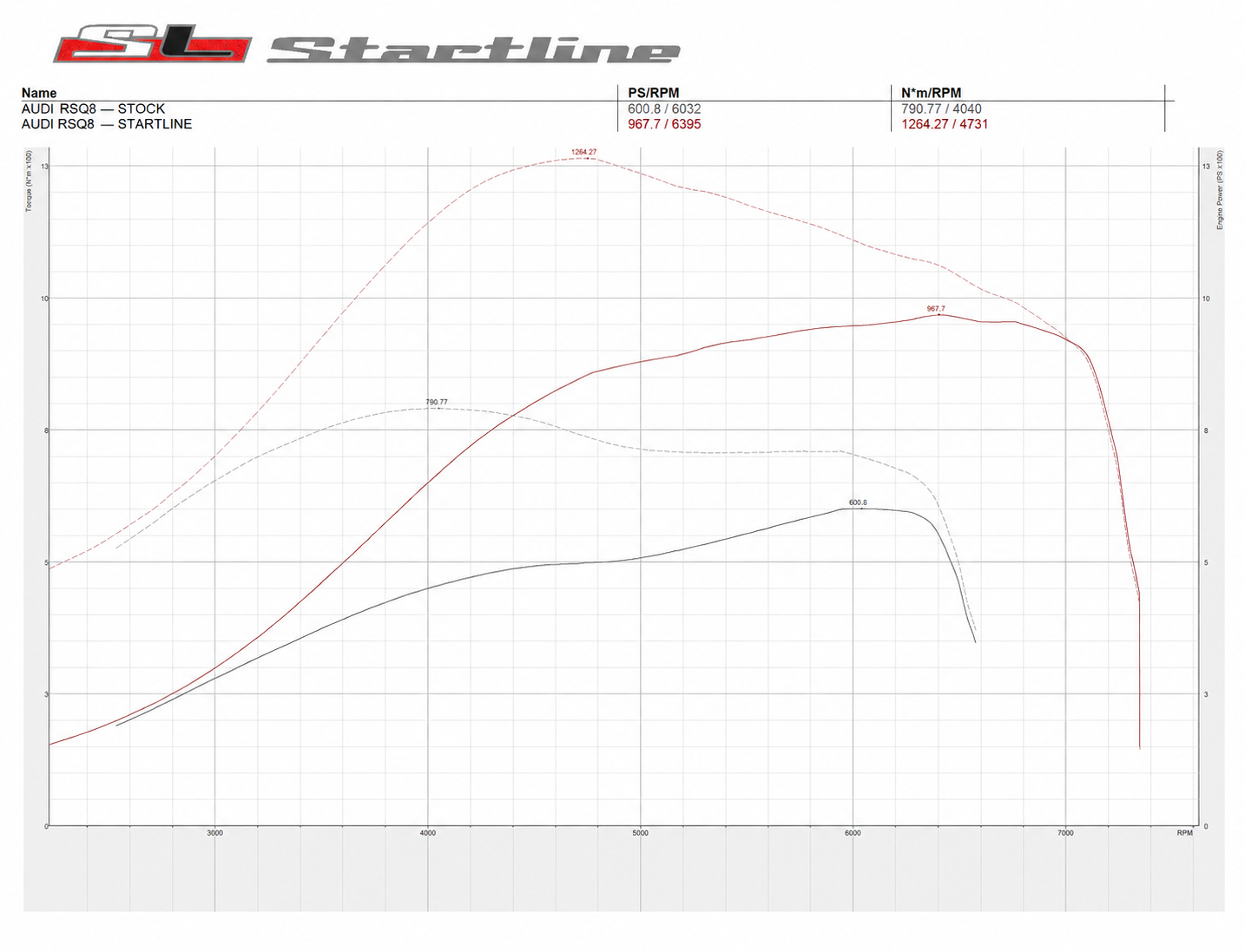
967.7 PS and 1264 Nm — the final dyno result
The final measurement recorded 967.7 PS at 6395 rpm and 1264.27 Nm at 4731 rpm. The baseline shown on the graph reached 600.8 PS and 790.77 Nm: a gain of 366.9 PS and 473.5 Nm between the two configurations.
Power rises steadily to approximately 6400 rpm, while torque remains above 1200 Nm across a broad midrange. The hybrid turbos, charge-air cooling, exhaust and calibration work as one matched system.
Why two small intercoolers became one large core
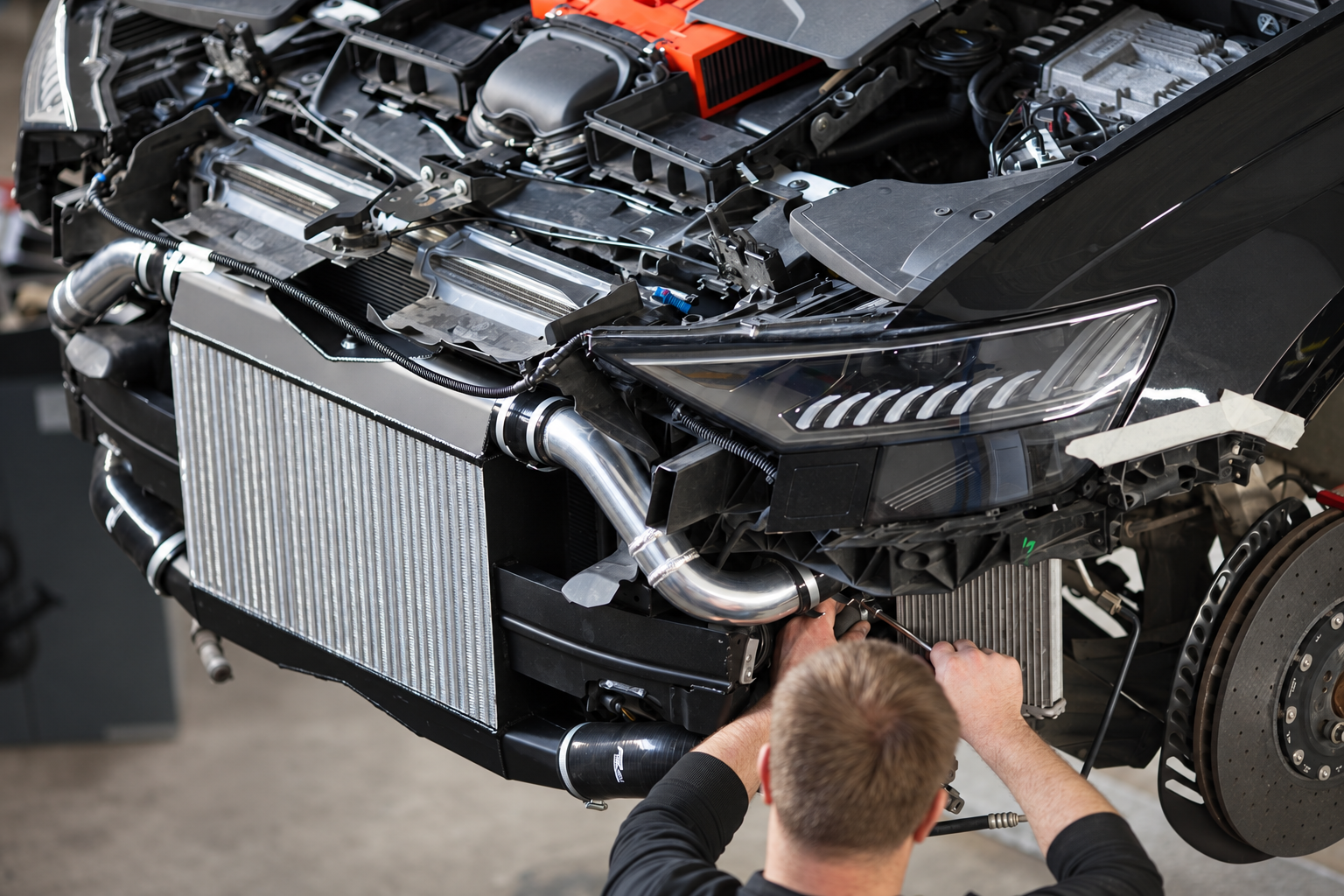
The factory layout cools compressed air through two separate smaller intercoolers. It is compact for standard airflow, but hybrid turbos require significantly more flow. Core dimensions, overall flow capacity, pressure drop and resistance to heat soak under repeated load all become important.
We removed the two small cores and fitted one large Nissan GT-R core at the front, chosen for its frontal area and flow capacity. We fabricated aluminium pipework, transitions and connections for the new layout, bringing both banks’ airflow together without unnecessary restrictions.
A large intercooler alone is not a complete solution. Restrictive end tanks, pipe diameters or bends can improve temperature while costing pressure and response. We designed the core and charge-air route together for effective cooling, high flow and predictable turbo operation.
Hybrid turbos and a freer-flowing exhaust
Hybrid turbochargers were selected to increase airflow while retaining a mounting architecture suited to the platform. Greater compressor capacity supplies the air mass required at higher rpm, while placing greater demands on charge-air cooling and accurate boost control.
The exhaust was adapted for increased gas flow. Reducing restriction downstream of the turbines helps reduce backpressure and lets the turbos use their capacity more effectively. The turbos, intercooler and exhaust each address a limitation that would otherwise hold back the other components.
Fuel supply: upgraded pumps and a Startlinemotors controller
With increased airflow and power, the factory fuel system could no longer meet this build’s demand. Higher-flow high-pressure fuel pumps were fitted to supply the additional fuel required.
The low-pressure pump received a Startlinemotors controller with power amplifier. It increases the pump drive’s electrical power reserve and supplies the high-pressure pumps with the fuel they need under heavy load.
Verified under load
After the mechanical changes, boost, fuel and torque management were calibrated for the installed specification. At this power level we monitor intake temperature, fuel system reserve, ignition corrections and boost stability throughout the run, as well as the power curve.
The 960 HP-class result required more than additional boost. Hybrid turbos deliver the airflow, the large intercooler controls its temperature, the exhaust reduces restriction and calibration brings the components together into a controlled system.