
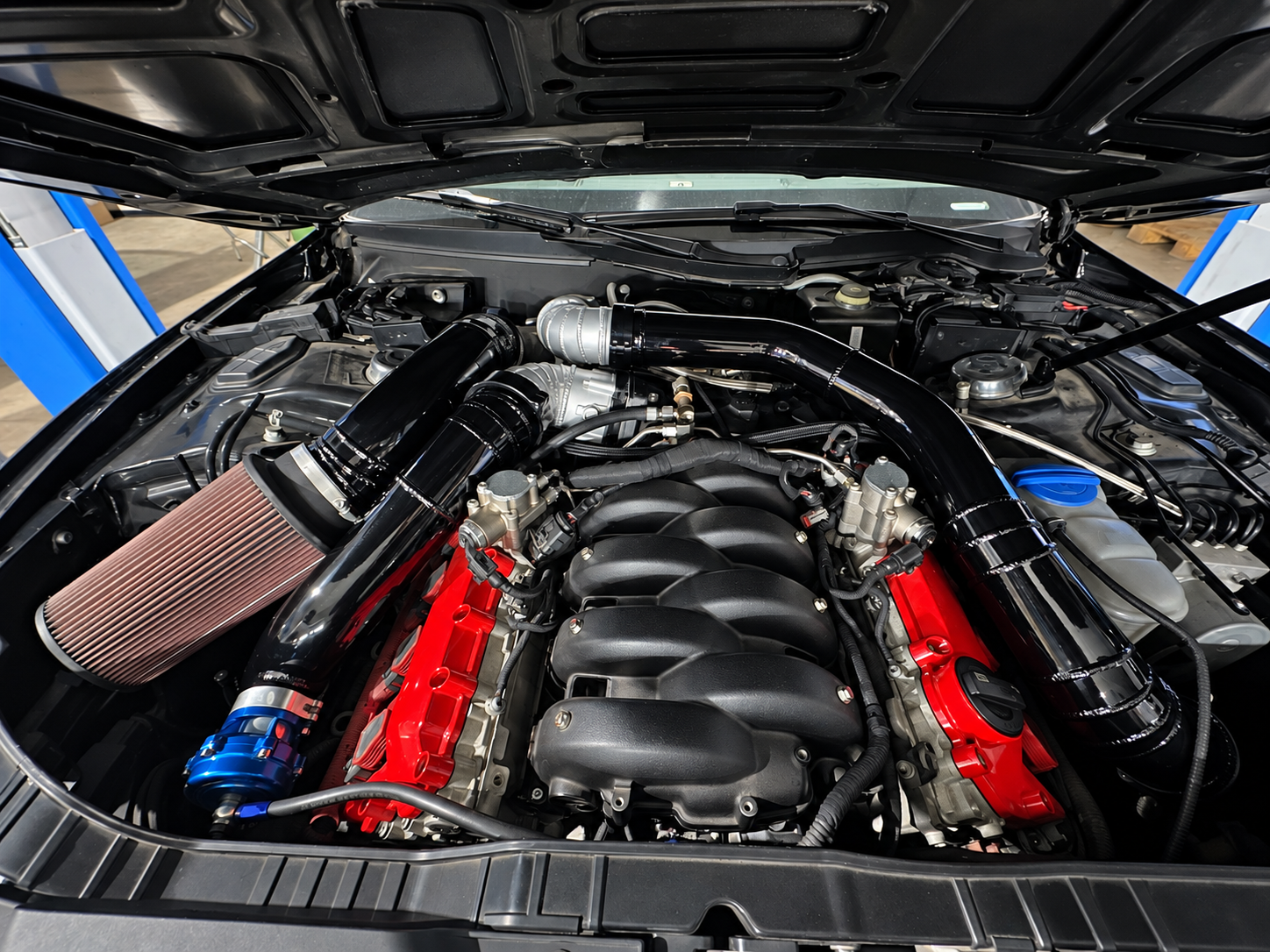
The engine, heads, air and fuel paths, transmission and boost control were developed as one system. The result was 890 WHP and 720 lb-ft, approximately 976 Nm, on the Mainline ProHub. A standard car on the same platform measured 60 HP below its manufacturer-rated output on this dyno, giving an estimated crankshaft output of around 950 HP for this build.
From a standard S5 to the current specification
| Mazgas | Gamyklinis pagrindas | Startline projektas |
|---|---|---|
| Oro tiekimas | Naturally aspirated 4.2 FSI | Garrett G42, 1250 HP-class single turbo |
| Variklio vidus | Standard pistons and connecting rods | Forged aluminium pistons and strengthened connecting rods |
| Galvos | S5 4.2 heads and valvetrain | RS5 4.2 heads, Supertech valves and upgraded springs |
| Kuro sistema | Standard low- and high-pressure fuel supply | Brushless pump, Startline controller, upgraded HPFP internals, RS4 injectors and methanol |
| Transmisija | Factory S5 transmission architecture | ZF8 conversion, strengthened hub and increased clutch capacity |
| Valdymas | Gamyklinis ECU | Factory ECU and separate Syvecs boost control |
890 WHP and approximately 950 HP at the crank
On the Mainline ProHub hub dyno the car delivered 890 WHP and 720 lb-ft, or 976 Nm. Using the 60 HP reference difference measured with a standard car on the same dyno gives approximately 950 HP at the crank.
A forged foundation for forced induction
The factory S5 4.2 FSI was designed as a naturally aspirated engine. Turbocharging changes cylinder pressure and thermal loads substantially, so standard pistons were replaced with forged aluminium items and the connecting rods with components intended for greater loads.
A forged piston differs in more than strength. Alloy expansion, geometry and weight affect the required clearances. We select clearances for the actual components and check protrusion, compression height and rotating assembly balance, preparing the bottom end for cylinder pressure rather than a theoretical power figure.
RS5 4.2 heads: airflow and valvetrain preparation
We used RS5 4.2 FSI heads. Audi describes the RS5 as a high-revving 4.2 V8 producing 450 HP at 8250 rpm, compared with the original S5’s 354 HP. The intake port openings on these RS5 heads are wider, providing geometry better suited to the required airflow.
Audi’s technical training material describes larger, flow-optimised intake ports, different timing and longer valve opening durations on high-revving 4.2 versions, along with stronger springs and valvetrain components. This explains the RS head’s suitability as a starting point for high airflow.
The heads received Supertech valves and upgraded springs. Spring capacity matters under boost and exhaust backpressure as well as at high rpm: insufficient spring force can compromise valve control before the mechanical rev limit is reached.
RS4 B7 intake manifold and direct injectors
We adapted a cast aluminium intake manifold from a 2007 B7 RS4. Audi describes it as a fixed-length design intended for high-rpm operation, without the dual-length switching used on the comfort-oriented 4.2. In this turbo build it provides a strong, free-flowing basis for distributing compressed air to all eight cylinders.
The direct injectors also come from the B7 RS4. Audi specifies higher-flow injectors for the high-revving 4.2’s increased fuel demand. Here they work with upgrades to both the low- and high-pressure fuel supply.
The complete fuel system: brushless pump, HPFP internals and methanol
A higher-flow brushless in-tank pump is controlled by our Startline Motors controller with power amplifier. Load-appropriate control and electrical reserve help maintain low-pressure supply when the high-pressure pumps demand maximum flow.
The high-pressure pumps received higher-capacity plungers. Their greater displacement delivers more fuel per stroke, helping maintain rail pressure where standard HPFP flow would become limiting. The low-pressure pump, HPFPs and injectors form a chain: upgrading only one can leave another as the bottleneck.
Methanol injection provides supplementary fuel and helps control intake and combustion temperatures. It is included in the overall calibration rather than used to conceal insufficient capacity in the primary fuel system.
RS5 exhaust manifolds and a custom single-turbo system
We used B8 RS5 4.2 exhaust manifolds as the starting point on the hot side. The standard S5 assembly was designed for a 354 HP naturally aspirated engine, while the RS5 produces 450 HP and operates up to 8250 rpm. The subsequent connections, turbo position and boost-control routing are custom-designed for this car.
Our workshop designed and fabricated the single-turbo system, pipework, wastegate and BOV installation around a 1250 HP-class Garrett G42. The wastegate controls turbine energy and boost, while the BOV releases compressed air when the throttle closes, reducing the returning pressure wave at the compressor.
The intercooler was also fabricated in-house. Thermal capacity, pressure drop, flow distribution and pipework volume matter as much as size. An undersized core increases intake temperature; excessive volume or poor design can increase response delay and pressure loss.
ZF8 conversion: transmission integration and mechanical capacity
Integrating the ZF8 automatic involved more than mounting it. Driveline layout, electronics and control logic were adapted to work with the factory engine ECU and quattro system.
The transmission received a strengthened hub and additional clutch friction elements. The hub carries mechanical load, while more friction area spreads torque and heat across a larger surface, increasing holding capacity and reducing slip risk at approximately 976 Nm.
Factory ECU and Syvecs boost controller: separate roles
The factory ECU remains responsible for direct injection, ignition, throttle, cam timing, protection functions and communication with the other control units. This retains the original electronic architecture despite substantial mechanical changes.
A separate Syvecs boost controller operates the wastegate to regulate boost to the selected target, rather than relying solely on a mechanical spring. It provides dedicated control for the added turbo system while the factory ECU retains its original responsibilities.
A complete system
No single part accounts for this S5’s result. The airflow required heads and manifolds; the additional air required a complete fuel system; cylinder pressure required a forged bottom end; and transmitting nearly 1000 Nm required mechanical preparation of the ZF8.
The final result is 890 WHP, 976 Nm and approximately 950 HP at the crank, with mechanical components and controls matched to work together at this level.