
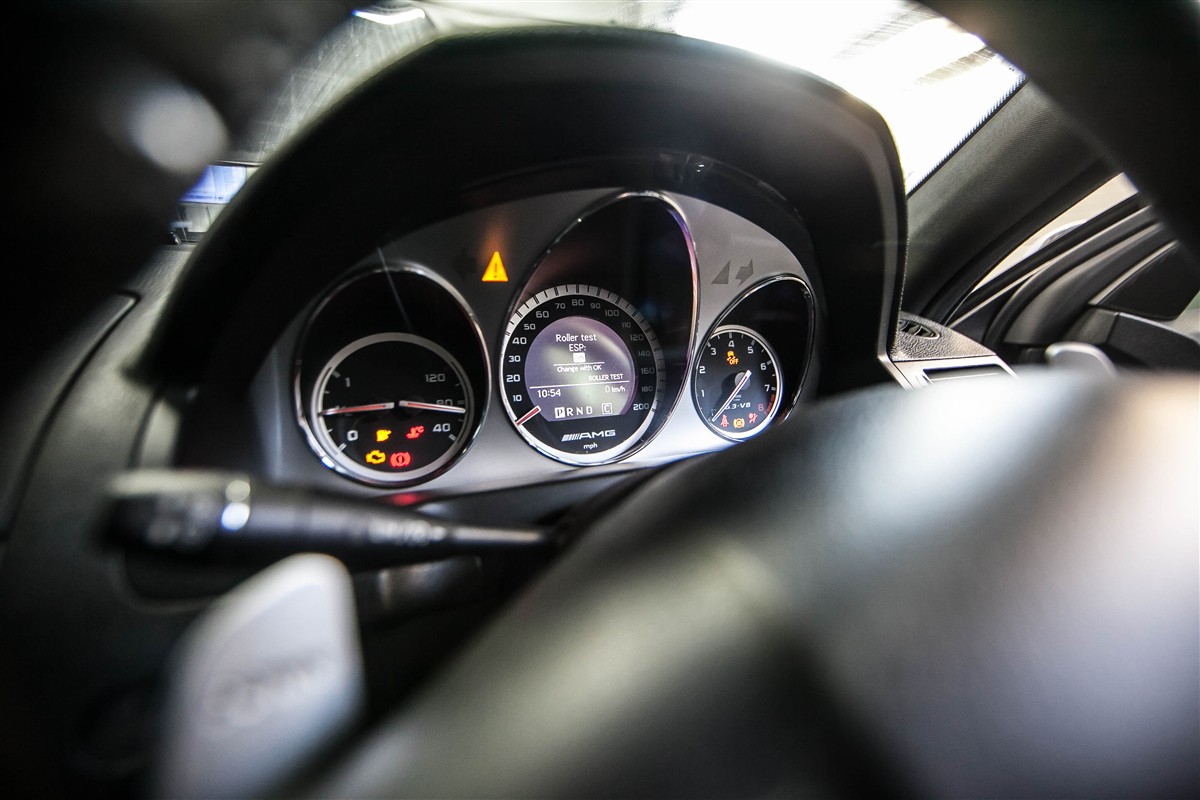
Diagnostics beyond reading codes
Reading fault codes is only the start. We investigate why the car loses power, hesitates, starts poorly or runs unevenly, using live data, relationships between readings and behaviour under relevant conditions rather than replacing parts in sequence.
Live data: how the car actually operates
Depending on available data, we assess airflow, intake and boost pressure, fuel pressure, temperatures, lambda, mixture and ignition corrections and misfires. Injection and cylinder-balance corrections matter on diesels too. No individual value constitutes a diagnosis on its own.
An idle reading often tells only part of the story. We monitor and, where needed, log data during starting, warm-up and changes in rpm or load. Testing is selected for the car’s condition; our dyno can reproduce load where appropriate.
Requested versus actual values
Where available, we compare ECU targets with achieved values, considering the size, duration, conditions and response of any deviation. Brief transient differences may be normal; repeated errors, slow response or saturated control can guide further checks.
Low boost does not automatically mean a failed turbo. We check sealing, control, actuators and sensor accuracy. Fuel-pressure deviations require supply and regulation checks, not immediately blaming one pump. Mixture or cylinder corrections may be effects rather than causes.
We interpret data using the engine design, manufacturer’s test conditions and actual specification. Units matter: absolute pressure differs from gauge pressure, and expected readings change with temperature, rpm and load. There is no single correct value for every car.
A fault can exist without a code
An empty fault memory does not prove the car is healthy. Codes require specific monitoring conditions. A deviation may be brief, intermittent or below the logging threshold. A sensor may produce a plausible but inaccurate signal, and mechanical faults do not always generate a code.
We do not ignore hesitation, power loss or uneven running simply because the Check Engine light is off. We review pending, historical and other-module faults and freeze-frame data where available, preserving useful information before clearing memory.
Hidden faults are not repairs
Some cars have code logging or warning functions disabled in software, deliberately or through unsuitable calibration changes. The light may stay off and the fault list appear clean while the mechanical or electrical problem remains.
If live data and vehicle behaviour conflict with diagnostics, we also assess the software. Checks may include ECU identification, monitoring readiness, available diagnostic information and prior tuning history. A code scan alone cannot verify every earlier modification.
Recently cleared memory and deliberately disabled monitoring are different. Incomplete readiness tests or empty memory do not prove concealment. Conclusions require several checks; our aim is to identify and resolve the cause rather than silence its warning.
A code guides diagnosis; it does not dictate a replacement part
A code naming a sensor may originate in power supply, connectors, wiring, air leaks, pressure control or another component. A cylinder correction does not automatically condemn an injector. Readings must be considered alongside the rest of the engine’s data.
We select targeted electrical, mechanical and actuator tests where supported. Diagnostic data narrow the search, while measurements distinguish causes from effects and reduce unnecessary parts replacement.
Modified cars are assessed for their actual specification
Tell us about changed turbos, injectors, air or fuel systems and ECU or TCU tuning before testing. Assessment uses the installed hardware and its control strategy; factory-data comparisons alone can mislead.
We check whether requested operating targets match the hardware’s capacity. Increased power does not justify persistent low pressure, unsuitable mixture or unstable operation. We distinguish condition, component selection and calibration issues.
Verification after the work
After agreed repairs or adjustments, we repeat checks under similar conditions where the car’s condition allows, compare data and confirm that deviations and the reported symptom have been addressed.
We explain confirmed findings, required work and remaining uncertainties. If an intermittent fault does not occur during testing, we discuss further monitoring. Tell us whether it happens cold, warm, under load or after particular repairs or tuning; this can be more useful than a code screenshot alone.
- Assessment of symptoms, previous work and specification
- Fault and freeze-frame checks where available
- Live-data and requested-versus-actual comparisons
- Targeted checks based on the observed deviations
- Clear findings, agreed solutions and verification after work