
Mechanika ir valdymas — vienas suderintas sprendimas
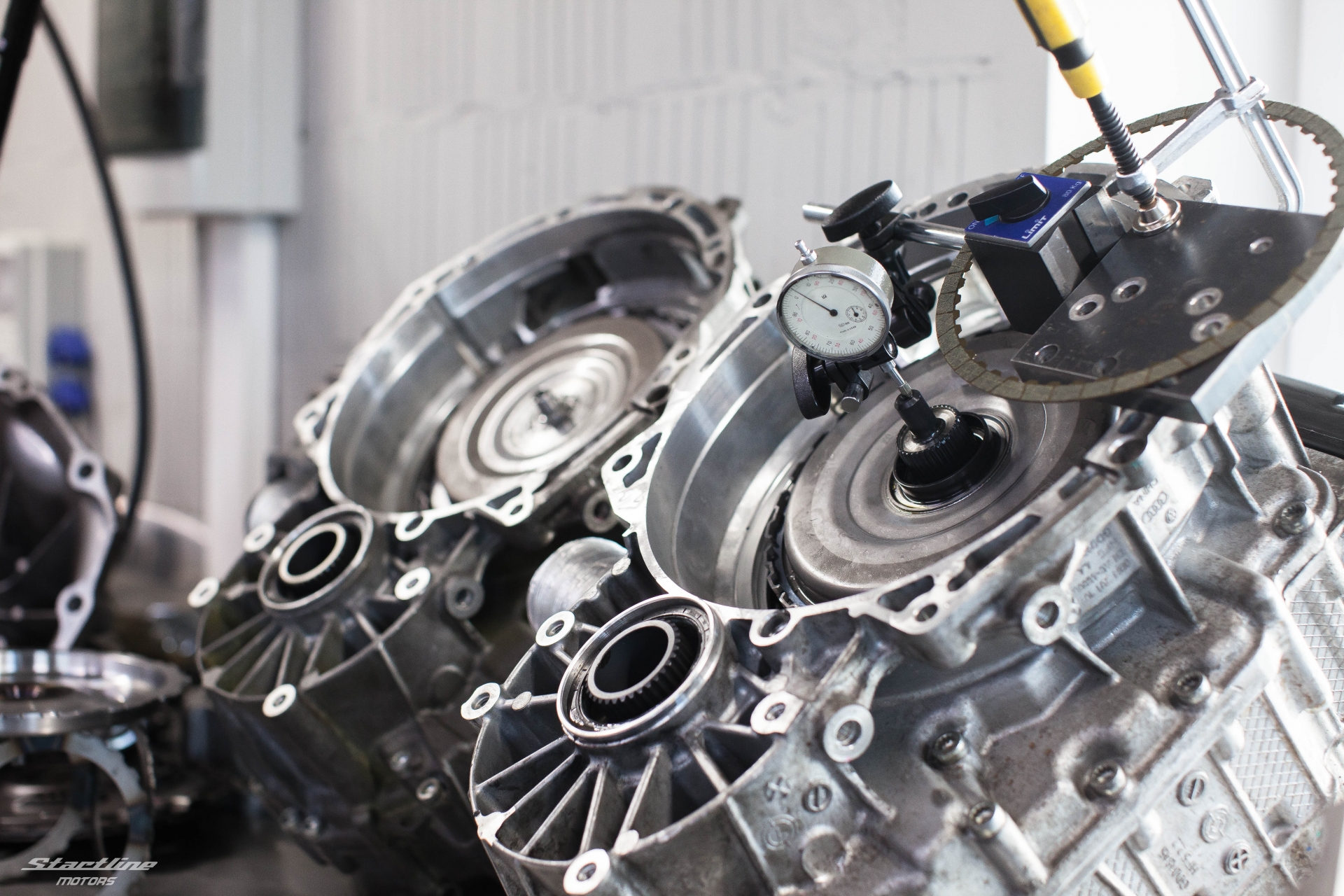
Repair resolves faults, strengthening prepares a transmission for higher loads, and calibration helps use its capacity correctly. We select the scope for the car, condition and intended use. Audi quattro S tronic to ZF 8HP conversion is covered separately.
More about the Audi quattro S tronic to ZF 8HP conversion
Diagnosis and repair: identify the cause first
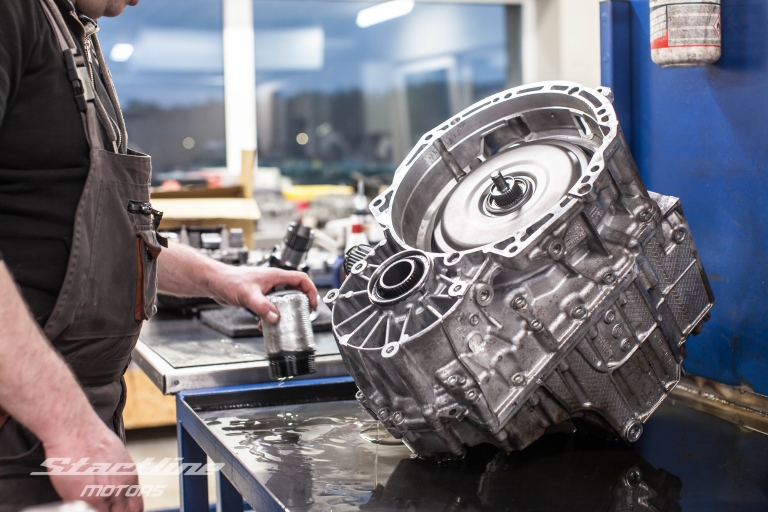
We repair automatic and manual transmissions. Before dismantling, we establish when symptoms occur: cold, warm, engaging gears, shifting or accelerating. Available automatic-transmission data may include input and output speeds, temperature, shift behaviour, clutch slip and adaptations. One code or adaptation value is not a final diagnosis.
Harsh shifts, delayed engagement and slip can arise from control, hydraulics, worn clutches or mechanical damage. On manual cars, clutch and other driveline faults must be distinguished from gearbox problems. Targeted checks establish what actually needs repair.
Where dismantling is needed, we confirm the scope from component condition and agree it with the customer. Fluid changes, adaptation resets and aggressive software cannot replace necessary mechanical repair.
Preparing transmissions for more power and torque
We strengthen transmissions for performance builds as well as repair them. Torque delivery, vehicle weight, grip, launch method, load duration and repeated runs matter alongside peak power. Daily cars and competition builds may need different solutions.
We select clutch packs and load-bearing components for the transmission and project. Where suitable upgrades exist, this may include drums, baskets, hubs, shafts and other critical parts. There is no universal strengthened-transmission kit: we address the limits of the specific design.
Clutch capacity depends on friction materials, working area, condition and precise assembly as well as commanded pressure. Packs and clearances are matched to component requirements. Calibration cannot compensate for incorrect assembly.
Sustained and repeated loads raise temperature, so we assess oil circulation and cooling. Stronger clutches alone do not solve overheating. Mechanical changes are followed by calibration, required adaptations and functional checks. Output targets are agreed for the complete setup, not promised from one upgraded part.
Strengthening ZF 8HP transmissions
8HP70, 8HP75 and 8HP76 have different designs and cannot share one output limit. Increased torque loads clutches, hubs, drums and planetary components. The limiting part depends on version, condition, mass, grip and launch intensity.
The 8HP70 E-clutch hub can suffer spline wear or breakage and clutch-plate notching. D-hub spline wear also occurs in 8HP55/70/75 designs. High-output 8HP76 builds require assessment of the P2 planetary carrier. Slip and temperature matter too: a hot pack may lose holding capacity before a hard part breaks.
Matched friction and steel plates, and additional plates where the design permits, increase clutch capacity. The Dodson SUPERSTOCK 8HP76 kit, for example, adds three plates each to the C and E packs. Correct clearance, supports, oil supply and cooling remain essential, followed by TCU calibration and load testing.
Power alone cannot predict hub failure. Dodson recommends an upgraded E hub above 750 hp for its 8HP76 SUPERSTOCK kit. This is kit-selection guidance, not a universal factory-hub failure point. Torque curve, launch shock, repeated loads, temperature and wear all matter.
We identify the exact transmission and inspect its components before selecting upgrades. Even 8HP70 E hubs can have 38 or 48 splines. More clutch plates or pressure cannot resolve an insufficient hub or P2 carrier; the correct mechanical component is needed for the intended output and use.
Engine and automatic transmission must work together
ECU and TCU exchange torque, rpm and load information. The transmission selects gears and can request temporary engine-torque reduction. Good calibration coordinates the powertrain rather than simply increasing power or shift harshness.
TCU programavimo nauda
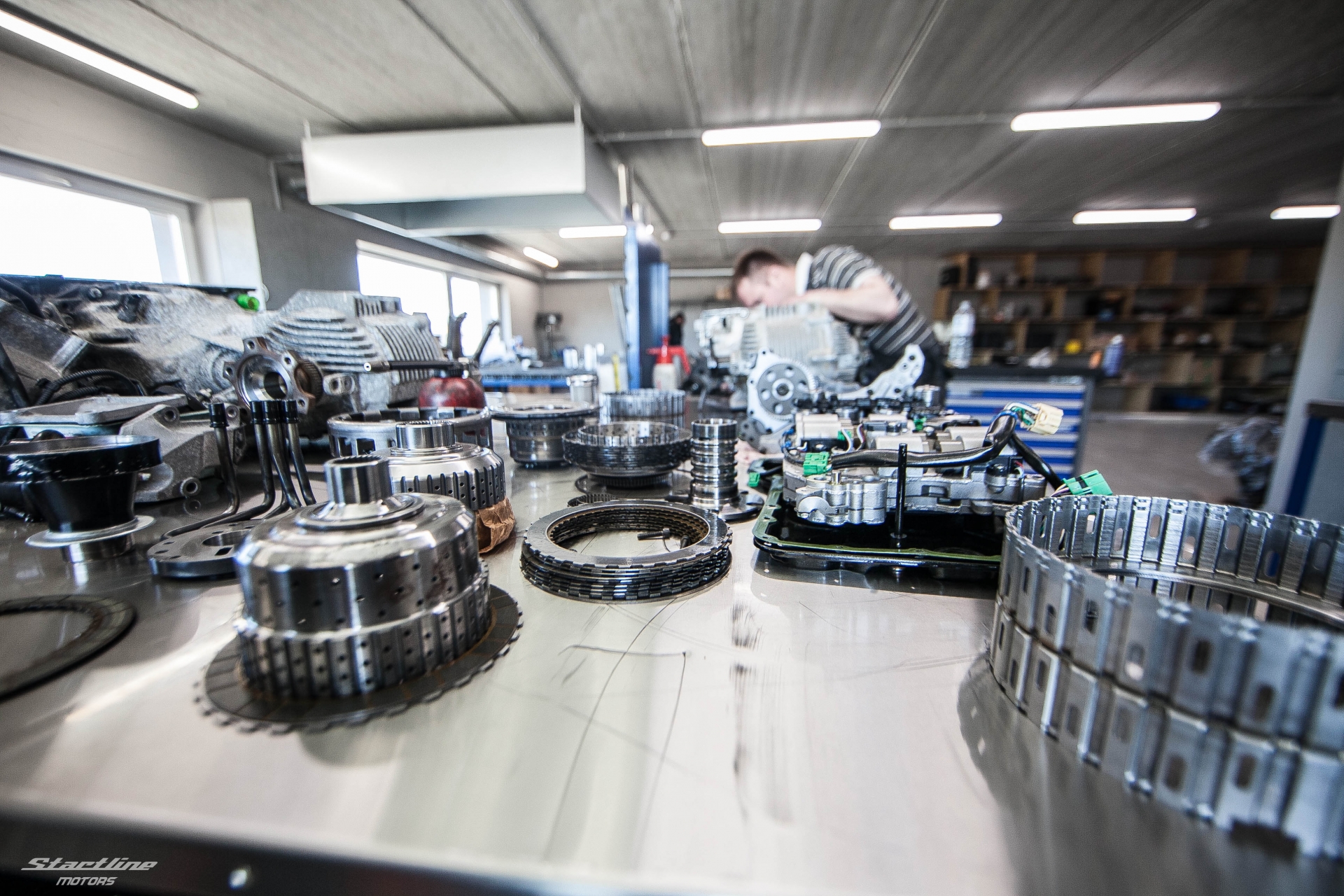
Where supported, we adjust gear selection, shift points, throttle and manual-command response and shift behaviour. Smooth everyday operation and appropriate gearing under acceleration are both important. Drive and sport modes need not behave identically.
Torque-converter automatics and dual-clutch transmissions such as DSG or DCT need different control strategies. Depending on the design, lock-up, clutch control and shift torque can be adjusted. No universal settings suit every transmission.
TCU calibration does not increase engine power by itself. Appropriate gear selection and coordinated shifts can improve response and acceleration. Harshness is not the goal: the transmission should work consistently at light and heavy loads.
ECU galios didinimas ir TCU ribos
Where engine torque exceeds transmission calibration limits, some TCUs request ECU torque reduction. This can prevent full use of the engine’s potential. Limits may vary by gear, temperature and other conditions rather than applying uniformly across rpm.
We coordinate ECU torque delivery with TCU limits, clutch control and actual mechanical capacity. Where TCU access is limited, more conservative ECU torque may be appropriate. Reliable power transfer matters more than a software number.
TCU tuning is not compulsory after every ECU change. Stock software may remain if torque stays within suitable limits and operation is correct. We decide using transmission version, software and checks, not the Stage label alone.
Teisingi sukimo momento duomenys TCU valdyme
In many systems torque is estimated by the ECU rather than continuously measured by a dedicated sensor. The TCU uses this information to set clutch pressure, so an inaccurate torque model affects operation directly.
If actual torque exceeds what is reported, clutch pressure may be insufficient. Adaptations cannot always compensate, risking slip, heat and wear. Under-reporting torque to bypass a limit is not equivalent to proper ECU/TCU coordination.
Communication and meaningful protection functions must remain effective. Disabling all torque limits or ECU/TCU interaction is not a universal solution and can impair shifts and protection.
Faster is not always better
Shift quality depends on coordinated clutch release and application, hydraulic pressure where applicable and engine-torque reduction. Too little torque reduction can increase clutch load and even prolong shifts; too much impairs power recovery.
Maximum pressure at all times or eliminating torque reduction is not automatically beneficial. Pressure and shift behaviour are matched to load and design capacity. Comfort and repeatability matter alongside fast sport-mode shifts.
Software torque limits and mechanical strength are different. Calibration cannot replace clutches, strengthen shafts or increase cooling capacity. Higher-output builds may need mechanical upgrades and better cooling too.
TCU derinimas su gamykliniu arba programuotu ECU
Scope is selected for the target. TCU changes can benefit a stock engine, but not every car needs both controllers modified. Stage names differ between suppliers; the actual calibration and application matter.
| Situacija | Ko galima siekti? | What must be assessed? |
|---|---|---|
| Gamyklinis ECU, derinamas TCU | More suitable gearing, response and shift character. | Engine power does not increase by itself; available functions depend on the transmission. |
| Programuojamas ECU, originalus TCU | More engine power with original transmission software. | Whether torque is within transmission limits and reported correctly. |
| Suderinti ECU ir TCU | Limits, clutch control and shifts matched to the torque curve. | Condition, cooling and coordinated controllers, not only peak power or torque. |
| Mechaninis stiprinimas ir suderintas valdymas | Greater torque capacity for the build. | The complete transmission design, component limits, assembly, cooling and real loads. |
Condition first, calibration second
We identify transmission and controller versions, tuning options, existing ECU changes and intended use. Faults, history and operation are assessed first. Slip, harsh shifts, overheating and damage are not reasons to install more aggressive software.
After changes, we test different loads and modes using the available diagnostic data. Adaptations are performed only when the procedure requires them; resets do not replace repairs. The goal is coordinated operation suited to the car, not a claim that one calibration solves every fault.
- Assessing faults and mechanical and hydraulic condition
- Agreeing repair scope from test findings
- Selecting reinforcement components and cooling requirements
- Assessing the transmission and available calibration options
- Coordinating ECU torque models and TCU limits where required
- Calibrating gear selection, shifts and clutch control
- Functional verification and explanation of mechanical and software limits